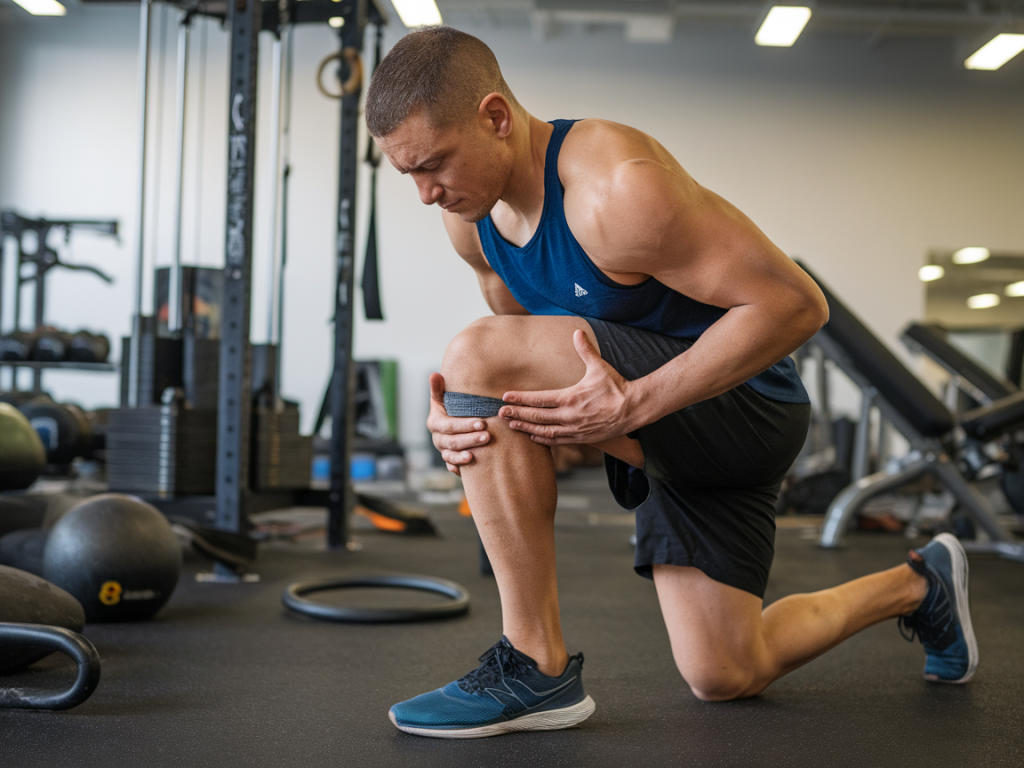
I’ve learned the hard way that ignoring tight hips, hunched posture, and weak glutes will eventually whisper — then shout — at me in the form of knee pain after a long run. Over the years I’ve built a short, simple mobility and micro-strength sequence that I use after runs (or on rest days) to calm niggles and help prevent them from becoming something worse. It takes about 15 minutes, needs minimal kit, and focuses on the joints and muscles that most directly influence knee tracking: hips, calves, quads, hamstrings, and the glute complex.
Why this sequence works
When I’m consistent with these movements I notice fewer twinges around the kneecap and less soreness after longer miles. The approach is intentional: first we release and mobilise restricted tissues, then we add tiny, targeted strength work (microstrength) to reinforce healthy movement patterns. That combination — mobility + microstrength — helps knees track better through the gait cycle.
What you’ll need
- Comfortable mat or soft surface
- Mini loop band (optional but helpful)
- Foam roller or massage ball (tennis ball or lacrosse ball works)
- 2–3 minutes of quiet breathing to centre yourself
Sequence overview (15 minutes)
I break the session into three blocks: release & mobility (7 minutes), activation & microstrength (6 minutes), and integrated movement (2 minutes). Below I give cues, progressions, and common mistakes to avoid.
Release & mobility (7 minutes)
- Calf self-massage — 90 seconds
Sit on the floor with a foam roller or massage ball under your calf. Roll slowly, pausing on tender spots for 10–15 seconds. Aim to loosen the lower leg; tight calves change ankle mechanics which increases stress at the knee. - Quad soft tissue — 60 seconds each side
Lying prone, use your forearm to press a ball into the front of the thigh and move slowly. If you don’t have a ball, press gently with your hands and breathe into the area. The goal is to relieve anterior tightness that can pull the patella (kneecap) off track. - 90/90 hip mobility — 90 seconds
Sit with one shin in front (90°) and the other to the side (90°). Lean forward and rotate gently toward the front leg to feel internal rotation, then rotate away for external rotation. Repeat slow controlled movements. This opens up hip rotation often lost from running flats. - Standing knee-to-wall ankle dorsiflexion test + mobilise — 60 seconds per side
Stand facing a wall, toe a few centimetres away, bend the knee to touch the wall. If you can’t reach comfortably, perform small ankle mobilisations: shift weight forward, bend knee, keep heel down. Improving ankle dorsiflexion reduces compensations at the knee.
Activation & microstrength (6 minutes)
These are small, controlled efforts designed to re-train firing patterns rather than build big muscle mass. Use a mini loop band for some movements if you have one.
- Banded side-stepping (glute med) — 2 sets of 20 steps (10 each way)
Place mini band above knees or at ankles. Keep a slight squat and step side to side with control. Cue: “soft knees, lead with the heel, resist collapse.” This warms the hip abductors that stabilise the femur and knee. - Single-leg mini stand-to-sit (micro eccentric) — 2 sets of 6–8 reps per side
Standing on one leg, reach the other leg slightly forward and lower your hips as if you were sitting to a very low chair, then control back up. Keep the knee aligned over the toes. This reinforces eccentric control of the quads and glutes—key for downhill and late-run fatigue. - Bridge with band press (glute max + external rotators) — 2 sets of 10
Lying on your back with the band above knees, lift hips into a bridge and press knees gently out against the band. Hold 1–2 seconds at the top. Focus on squeezing glutes, not overarching the low back.
Integrated movement & cool-down (2 minutes)
- Walking lunge with thoracic rotation — 1 minute
Step forward into a shallow lunge, then rotate your torso toward the front leg, arms open. This connects hip mobility with torso rotation and helps maintain coordinated stride mechanics. - Three deep belly breaths lying down — 1 minute
Finish supine, knees bent. Breathe into the belly and pelvis to calm the nervous system. Recovery and sleep are big players in injury prevention — a calm body repairs better.
Common questions I get
- How often should I do this?
I recommend 3–5 times per week if you are running regularly. After long runs, I always do it within an hour. On easy days, a shorter 7–10 minute version focusing on release and one activation is enough. - Does this replace strength training?
No. This is a complementary routine. Think of it as targeted maintenance. I still do full strength sessions (squats, deadlifts, lunges) 1–2 times weekly to build robust muscles. - Will it fix my pain?
If your knee pain is acute, severe, or persistent, please see a clinician. This sequence is designed to reduce common overuse niggles and improve mechanics, but it’s not a diagnosis or cure-all for structural issues. - Can I do this before a run?
Yes — but keep pre-run versions lighter and more dynamic: short calf and hip mobilisations, a few banded steps, and activation sets with fewer reps. Save the deeper soft-tissue work for after your run.
Progressions and tracking
If your knees are improving, add load or complexity gradually: increase bridge holds, add a small kettlebell to single-leg stands, or do tempo single-leg squats. Track a simple metric: pain level during and after runs (0–10) and how you feel two days later. If pain drops consistently over 2–4 weeks, you’re on the right path.
Gear and product notes
I often use a lightweight mini loop band (I like the 3-pack bands from Fit Simplify), a dense foam roller (Amazon or local sporting stores), and a lacrosse ball for deep spots. Nothing fancy required — consistency beats expensive gear.
Try this for two weeks and notice the small differences: less tightness, steadier knees on tired miles, and more confidence in your recovery. If something hurts sharply while you do an exercise, stop and seek personalised advice. Otherwise, keep it gentle, keep showing up, and let the small changes add up.