I used to treat hip mobility as something I would “get to later,” right after the bigger, flashier parts of fitness. Strength work felt more productive. Cardio felt more measurable. Mobility felt optional, until my hips started reminding me that tightness does not stay polite forever. Sitting, stress, hard workouts, and long days at a desk can make hips feel stubborn, and once that happens, movement starts to feel smaller, less fluid, and sometimes painful. What changed everything for me was not a dramatic stretch session or a perfect routine. It was building a realistic weekly mobility plan I could actually repeat.
I want this article to feel practical, because that is what works in real life. I do not believe in an elaborate plan that looks impressive for one week and disappears the next. I believe in a simple rhythm that supports your body, fits into your schedule, and gives your hips enough attention to stay open, supported, and comfortable. When I work with mobility now, I think in terms of consistency, variety, and recovery. I also think in terms of function: can I squat without pinching, walk without stiffness, and train without feeling like my hips are always the weak link?
Why hips get tight so easily
Tight hips are rarely just about one muscle being “short.” More often, they reflect a mix of habits and stressors. Long periods of sitting can leave hip flexors feeling compressed. Repeated training can create tension in the glutes, adductors, and deep rotators. Stress can change breathing patterns and make the body hold itself more rigidly. Even sleep quality can affect how well tissues recover. I have seen this in myself more times than I can count: if I am under-recovered, my hips usually tell me before anything else does.
That is why I do not chase random stretches anymore. Instead, I look at the full picture. I ask whether I need more movement variety, more recovery, more glute activation, or more time in positions that help the hips rotate and lengthen gently. The goal is not to force flexibility. The goal is to improve mobility, which means creating usable range with control.
What a realistic weekly mobility plan actually looks like
A realistic plan is one you can keep even during a busy week. I usually structure mine around three layers: a short daily reset, a few focused mobility sessions, and small movement snacks spread through the day. This makes the work feel manageable instead of overwhelming. I do not need a full hour every day to make progress. I need repetition.
For most people, I think a weekly plan should include:
- Daily movement for five to ten minutes, especially after sitting for long periods
- Two to three focused sessions of 15 to 25 minutes each
- Gentle active recovery on harder training days
- Breathing and downregulation so the body can actually release tension
- Enough strength work to support the new range of motion
The key is that mobility should support your life, not become another exhausting item on your to-do list. If a plan feels too strict, I will not follow it for long. So I build around my existing routine: before a workout, after a walk, while coffee brews, or during a short break in the afternoon. Those tiny windows matter more than people think.
The movement patterns I rely on most
When my hips feel tight, I do not only stretch the front of the hip and call it done. I try to cover the main actions the hips are built for: flexion, extension, rotation, abduction, and adduction. That means my plan includes a mix of positions, not just one favorite stretch repeated forever.
Some of my most useful patterns are:
- Hip flexor openers with glute engagement, so I can lengthen the front of the hip without dumping into the lower back
- 90/90 transitions for internal and external rotation
- Deep squat holds if my ankles and knees are happy enough to support them
- Adductor rocks to ease inner thigh tension and improve side-to-side freedom
- Glute bridges and split-stance loading to build strength in the range I want to keep
- Controlled leg circles to improve joint control without rushing
I like pairing mobility with activation. For example, if I open the hip flexors, I often follow with a glute bridge or a split squat variation. That helps my body understand where the new range is supposed to come from. Without that, I might feel looser for a moment but still move the same way later in the day.
A weekly structure I actually use
Here is the kind of structure I find sustainable. It is not rigid, and I change it based on training, stress, and how my body feels.
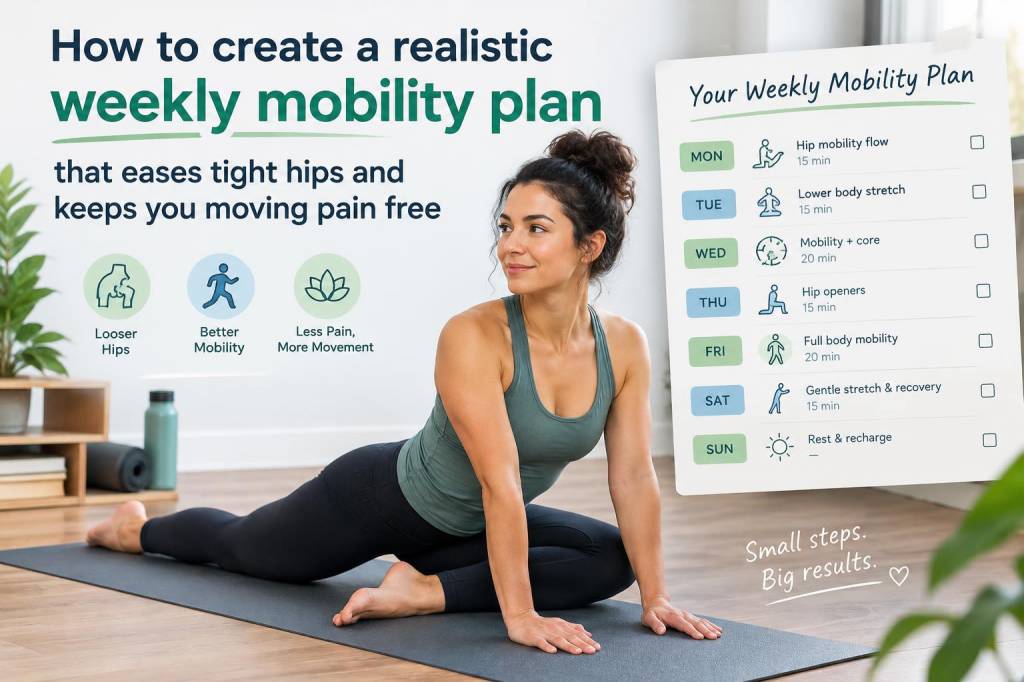
| Day | Focus | Time | What I do |
| Monday | Reset | 10 minutes | Breathing, gentle hip circles, adductor rocks, hip flexor opener |
| Tuesday | Strength plus mobility | 20 minutes | Glute bridges, split squats, 90/90 transitions, short cooldown stretch |
| Wednesday | Recovery | 5 to 15 minutes | Walk, light dynamic flow, breathing, gentle squat hold |
| Thursday | Rotation focus | 20 minutes | 90/90 work, controlled leg lifts, seated rotation drills, adductor work |
| Friday | Reset | 10 minutes | Simple flow before bed or after work |
| Weekend | Longer session | 20 to 30 minutes | Full-body mobility circuit with extra hip attention |
This table is not a rulebook. It is a starting point. Some weeks, I shift one session to a walk outside. Some weeks, I shorten everything because life is full. What matters is that I keep a rhythm. A little done often beats a lot done rarely.
How I keep mobility from feeling boring
I used to think mobility had to be slow and tedious. Now I make it feel like a small ritual. I put on music, keep props nearby, and choose movements that feel good enough to repeat. I also track what changes I notice: easier squatting, less stiffness after sitting, fewer pinchy moments when I get out of the car. That feedback keeps me motivated.
I also rotate the focus so I do not get stuck doing only one stretch. One week I might prioritize hip flexors and rotation. Another week I might spend more time on adductors and deep squat comfort. Variety helps me stay engaged and helps the hips adapt from multiple angles.
Another thing that helps is starting smaller than I think I need. If I wait for a perfect 30-minute window, I often miss the chance entirely. If I commit to five minutes, I usually do more once I begin. That is one of my favorite lessons from mobility work: action creates momentum.
What to do when your hips feel painful instead of merely tight
There is a difference between a muscle feeling stretched and a joint feeling unhappy. If I feel sharp pain, deep pinching, numbness, radiating discomfort, or pain that gets worse during a movement, I do not push through it. I scale back, simplify the pattern, or rest. Sometimes the answer is less intensity, not more. Sometimes it is better mechanics, not deeper stretching.
When hips feel genuinely irritated, I focus on low-threat movement: walking, gentle range work, light glute activation, and calm breathing. I also pay attention to sleep, hydration, and overall training load. If the discomfort lingers, I would rather speak with a qualified professional than keep guessing. Mobility should help you move better, not make you anxious about moving at all.
My simple rules for making progress
I keep a few rules in mind whenever I am building or adjusting my own plan:
- Keep sessions short enough to repeat
- Mix passive stretching with active control
- Match the plan to your actual week, not your ideal week
- Use breathing to reduce unnecessary tension
- Track function, not just flexibility
- Support mobility with strength and recovery
That last point matters a lot. I do not want mobility that only exists on a mat. I want it to show up when I bend, squat, walk, lift, and live. That is why I keep strength training in the picture. Strong glutes, stable core work, and controlled single-leg exercises help me keep the range I earn.
How I know a plan is working
I know my plan is working when everyday movements feel easier. I can sit for a while and stand up without feeling locked. I can warm up faster before training. I can move through a squat or lunge with less resistance. I also notice better recovery after hard sessions, because the hips are not carrying so much leftover tension.
For me, success is not having “perfect” hips. Success is moving with less friction. It is being able to enjoy exercise, take long walks, and handle normal daily life without feeling like my body is constantly negotiating with me. That is the kind of progress I care about, and it is exactly why a realistic weekly mobility plan matters so much.