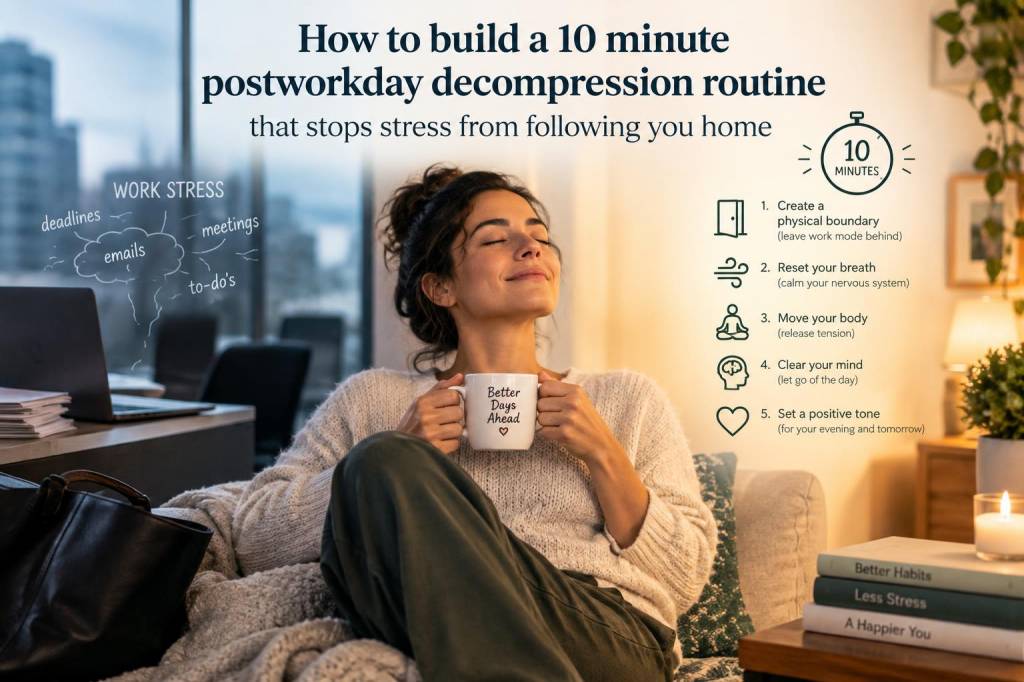
By the time I close my laptop, my mind can still feel like it is carrying a backpack full of unopened messages, unfinished tasks, and half-formed worries. For a long time, I thought I needed a whole evening to recover from a demanding workday. What I have learned instead is that a 10-minute decompression routine can change the entire shape of my evening. It does not erase stress, but it helps me stop stress from crossing the threshold with me and settling into my home like an uninvited guest.
I use this routine on busy days, quiet days, and especially on days when I feel mentally sticky, like my thoughts are still attached to my desk chair. It is simple on purpose. I do not want another performance, another complicated wellness project, or another task that feels like work. I want a small, repeatable reset that tells my nervous system: work is done, I am safe, and my evening belongs to me.
Why I need a transition between work and home
For me, stress does not always look dramatic. Sometimes it shows up as tight shoulders, shallow breathing, a short temper, or that restless urge to keep checking email even after I have stopped working. If I go straight from work mode into dinner, family time, or chores, I carry all of that tension forward. My body may be at home, but my mind is still at the office.
I started paying attention to this pattern when I noticed I was arriving home and immediately reacting to everything around me. A small question could feel overwhelming. A normal household noise could irritate me. I was not relaxed enough to enjoy my own evening. That is when I began treating the end of the workday as a transition rather than a cliff. Ten minutes became enough time to interrupt the stress loop and create a clean boundary.
What matters most is not doing a perfect routine. What matters is giving my brain a clear signal that a different part of the day has begun. Once I started doing that consistently, I noticed I could be more present, more patient, and more connected when I walked through my door.
My 10-minute routine, step by step
This is the exact structure I return to most often. I keep it flexible, because some days I need more movement and other days I need more stillness. Still, having a framework helps me avoid defaulting to doom-scrolling or carrying my inbox into dinner.
| Minutes | What I do | What it helps with |
|---|---|---|
| 1-2 | I pause, put away work tools, and change clothes if possible | Creates a clear boundary between work and home |
| 2-4 | I take slow breaths and relax my jaw, shoulders, and hands | Calms physical tension and lowers mental intensity |
| 4-6 | I move my body with gentle walking, stretching, or mobility work | Helps release built-up stress and restlessness |
| 6-8 | I do a quick mental dump on paper or in my notes app | Stops unfinished thoughts from looping in my head |
| 8-10 | I choose one recovery cue, like tea, music, dim light, or silence | Signals that recovery time has started |
Why I start by changing my state, not my thoughts
I used to think decompression meant I had to solve my stress with logic. I would sit down and try to think my way out of feeling overwhelmed. That rarely worked. My body was still tense, so my mind kept acting as if danger were near. Now I start with state change first.
That means I begin with something physical: taking off my work shoes, washing my hands, stepping outside for fresh air, or rolling my shoulders back. I like actions that are small enough to feel almost too simple. Those gestures matter because they create a visible break in the day. Once my body receives that message, my thoughts usually soften a little too.
I also pay attention to light. If I can, I lower harsh overhead lighting and use softer lamps. Bright, frantic light can make me feel like I am still in execution mode. A gentler environment helps me shift into recovery. I have found that tiny environmental cues can be just as powerful as mindset work.
The breathing reset I use when work still feels loud
When I am especially wired, I do not start with a long meditation. I keep it basic. I sit or stand still and take slow breaths through my nose, then exhale longer than I inhale. A longer exhale helps me feel like my system is slowing down. I usually repeat this for one or two minutes while relaxing my tongue and unclenching my hands.
If my mind is very busy, I count my breath cycles. Sometimes I use a simple pattern: inhale for four, exhale for six. Other times I just focus on making each exhale feel a little heavier and slower than the last. I am not trying to force calm. I am trying to make calm easier to access.
I also remind myself that I do not need to feel amazing in ten minutes. I only need to feel a little more available to my evening. That shift in expectation helps a lot. It makes the practice feel realistic instead of demanding.
Movement that helps me leave work behind
Gentle movement is one of my favorite parts of the routine because stress lives in my body as much as in my thoughts. I do not need a workout after work every day. Sometimes a few minutes of movement is enough to shake off the stuck feeling that builds during sitting, typing, and problem-solving.
My usual options are simple:
What I love about this part is that it is practical, not performative. I am not trying to “earn” rest. I am using movement to help my nervous system let go of the workday. Even three minutes can make me feel less compressed.
The mental reset that keeps stress from following me indoors
One of the biggest changes for me came from doing a quick brain dump. I keep a notebook near my bag, and I write down anything that feels unfinished, urgent, or annoying. I do not organize it. I do not edit it. I just get it out of my head.
This matters because my brain loves to rehearse unfinished loops. If I do not capture those thoughts somewhere, they follow me into the kitchen, the sofa, and sometimes even into bed. Writing them down gives them a place to live outside of me. I often add a very small next step beside each item, such as “reply tomorrow morning,” “buy groceries,” or “review after lunch.”
I also like asking myself one gentle question: What actually needs my attention now? Most of the time, the answer is “not much.” That reminder helps me separate true priorities from anxious noise. It reduces the feeling that I must remain mentally on call all evening.
The sensory cues I use to shift into home mode
I pay attention to sensory detail because it helps my brain understand that the pace has changed. Music is one of my favorite tools. I have a few playlists that are calm, steady, and familiar, with no songs that make me feel rushed. Sometimes I choose instrumental tracks, because lyrics can feel too stimulating when I am already overloaded.
Tea is another small ritual I enjoy. Not because it is magical, but because it gives my hands something to do while my body settles. A warm mug can feel grounding after a day of screens and deadlines. If I am not in a tea mood, I will make sparkling water with lemon, or simply drink a glass of water slowly and mindfully.
I also use smell when I want a stronger reset. A softly scented candle, a few drops of essential oil in a diffuser, or even the smell of freshly washed clothes can make home feel distinct from work. These cues are not about luxury. They are about association. Over time, my brain learns that these sensations mean safety, softness, and release.
What I avoid during my decompression window
Just as important as what I do is what I avoid. I try not to open email again. I try not to start an intense conversation before I have settled. I try not to use those first ten minutes to catch up on messages, news, or social media. Those things pull my attention outward when I need it to come back into my body.
I also avoid making my decompression routine another place to judge myself. Some days I have no patience. Some days I am distracted. Some days I only manage three minutes of breathing and one shoulder stretch before life interrupts. I do not treat that as failure. I treat it as information. If I am honest, imperfect consistency has helped me far more than all-or-nothing discipline ever did.
What changes when I protect this short ritual
When I honor this transition, my evening feels more mine. I am less likely to snap at small things, less likely to carry work thoughts into dinner, and less likely to feel drained before the night even begins. I also sleep better when I do not let the workday linger in every corner of my evening.
There is something deeply relieving about deciding, every day, that I do not need to stay mentally attached to work after hours. Ten minutes is enough to reclaim myself. It does not require special equipment, a perfect schedule, or a full wellness overhaul. It asks for attention, repetition, and a little kindness.
If you want to adapt this to your own life, start with one action that feels easy enough to repeat tomorrow: a short walk, a breathing pause, a notebook dump, or a cup of tea in a quiet room. Then notice what changes in your shoulders, your jaw, and your mood. That is usually where I see the first signs that stress is finally being left at the door.