I wanted a small corner in my flat where I could escape the hunched posture and neck tension that come with long days at my desk. What began as a way to interrupt pain turned into a deliberate "mobility corner" — a compact, inviting space with clear spacing rules, simple props, and repeatable 12-minute flows that I use whenever my shoulders tighten or my hips feel stiff. Below I share exactly how I set it up, why each item matters, and three short flows you can do in just 12 minutes to relieve desk-related pain.
Why a mobility corner beats random stretches
For me, consistency is everything. If a stretch takes too long, needs lots of space, or requires awkward equipment, I skip it. A dedicated corner reduces decision fatigue: I know where to go, what to use, and how long it will take. This encourages tiny daily habits that add up — five minutes in the morning, a 12-minute flow after lunch, or a quick reset between calls.
How much space do you actually need?
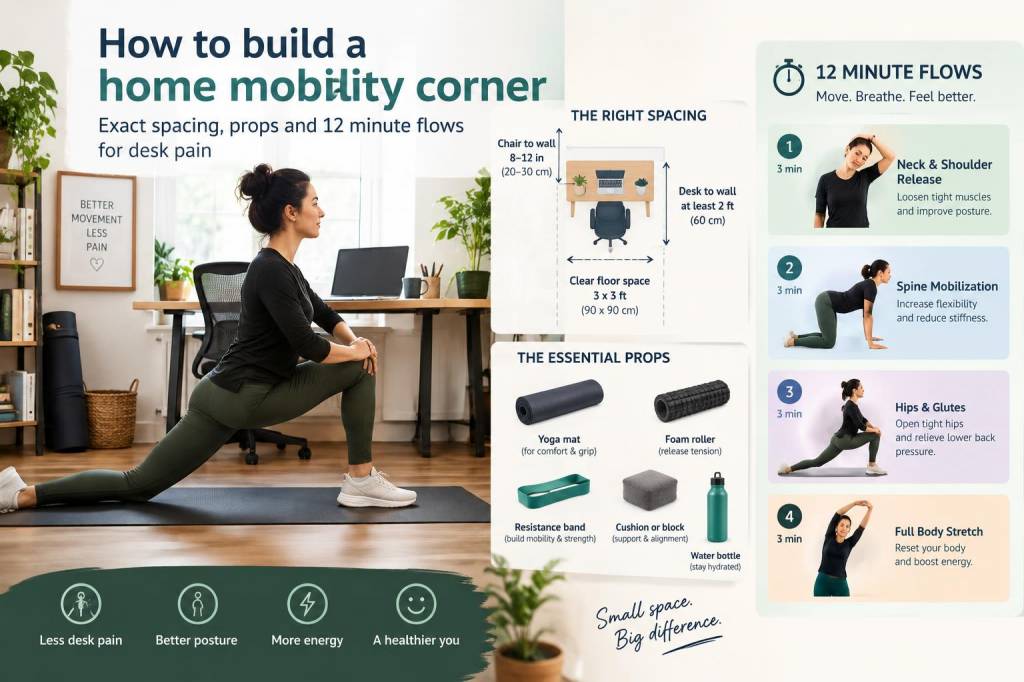
You don’t need a full gym. I carved out about the space of a yoga mat plus a small shelf. Here are exact spacing recommendations that work in small apartments and spare rooms.
| Element | Recommended space | Why |
| Floor area | 180 cm x 60 cm (yoga mat footprint) | Enough for lying, rolling, and lunges without knocking into furniture |
| Wall space | 60 cm width with 20–30 cm clearance | For wall-assisted stretches and breathing drills |
| Vertical clearance | 2 m | Ensure overhead movements are unobstructed |
| Storage shelf | 40 cm x 30 cm | Holds small props and makes the space feel tidy |
If you can’t free up 180 x 60 cm, try 150 x 50 cm — you’ll limit some movements, but seated mobility and smaller standing drills will still fit.
Essential props and why I chose them
I keep the prop list intentionally short. Each item is multi-purpose and inexpensive.
Yoga mat — provides a clean, grippy base for rolling, hip work, and stretches. I use a 4–5mm mat; thicker mats are nicer for knees.Foam roller (30 cm or 90 cm) — my go-to for thoracic mobility and glute release. A 30 cm roller is easy to store; a full-length 90 cm is better for spinal work if you have space.Resistance band (loop + long band) — small bands are great for shoulder activation and gentle pull-aparts; a long band helps with assisted lunges and hamstring work. I like TheraBand or Fit Simplify.Small bolster or firm pillow — supports the lower back during reclined thoracic extensions and helps open the chest.Massage ball (lacrosse or trigger point ball) — perfect for pinpointing upper back knots and plantar foot release.Chair or sturdy stool — for seated hip mobility, calf stretches, and elevated push-offs.How I arrange everything
I place the mat against a wall so I can use the wall for balance and chest-opening stretches. The shelf sits within arm’s reach and holds the band, ball, and a water bottle. The foam roller leans vertically in a corner. This setup makes the corner inviting rather than cluttered — you should be able to clear it in under a minute.
12-minute Flow A — Morning wake-up (spine, hips, shoulders)
Purpose: gently open the thoracic spine, mobilise hips, and activate shoulders. Do this as soon as you get out of bed or before starting work.
0:00–1:00 — Diaphragmatic breathing against the wall: stand or sit with your back to the wall, inhale for 4, exhale for 6. Feel ribs expand laterally.1:00–3:00 — Foam roller thoracic extensions: lie with the roller under mid-back, hands behind head, small extensions. Move the roller up and down slightly to find tight spots.3:00–4:30 — Cat-cow flow on mat: slow, 6–8 breaths focusing on thoracic movement more than lumbar.4:30–6:30 — World's Greatest Stretch (slow dynamic): lunge forward, rotate torso with arm reaching up, hold 2 breaths each side, 4 reps per side.6:30–8:30 — Banded shoulder pull-aparts: light band, 12–15 reps to activate the rear delts and scapular muscles.8:30–10:30 — Glute bridge with pulse: 3 sets of 10 pulses, brief rest between sets — wake the posterior chain.10:30–12:00 — Standing quad/hip flexor stretch: hands on wall or chair, 30–40 seconds per side, slow breathing to release tension.12-minute Flow B — Midday desk reset (neck, upper back, mobility)
Purpose: relieve neck stiffness and upper back tightness caused by forward head posture and prolonged sitting.
0:00–1:00 — Neck rolls and gentle chin tucks: 30 seconds each — slow and light.1:00–3:00 — Wall angels: stand with mid-back on wall, slide arms up and down for 10–12 reps, focusing on scapular sliding and keeping lower back neutral.3:00–5:00 — Thoracic rotation on all fours: reach one hand under stomach and rotate up, 8 reps each side.5:00–7:00 — Foam roller upper-back mobility: small extensions and openers, pausing on tender spots for 10–15 seconds.7:00–9:00 — Seated band pull-apart + external rotation combo: 3 sets of 8–10 slow reps.9:00–10:30 — Pec stretch in doorway or with a bolster: 45 seconds per side.10:30–12:00 — Box breathing and shoulder shrugs: 4-4-4-4 breaths, then slow shoulder rolls to settle tension.12-minute Flow C — After-work unwind (hips, hamstrings, sleep-friendly)
Purpose: help transition from work-mode to evening, reduce lower back tension and calm the nervous system.
0:00–1:00 — Supine diaphragmatic breathing with knees bent: 6–8 slow breaths.1:00–3:00 — Supine knee hugs into chest: alternate sides, 1 minute each — feel the low back soften.3:00–5:00 — Figure-four glute stretch on back using chair for support: 1 minute per side.5:00–7:00 — Hamstring band stretch with long band: slow 30–45 second holds each side.7:00–9:00 — Reclined thoracic opener on bolster or pillow: interlace fingers behind head, gentle hold and breathing.9:00–11:00 — Child’s pose to puppy pose flow: 30 seconds each, moving slowly with breath.11:00–12:00 — Progressive muscle relaxation: tense and release shoulders, neck, and glutes to cue relaxation before evening activities.Small habits that make the corner work
Keep a visible timer: I use a simple 12-minute setting on my phone or a kitchen timer. Short timers make it easier to commit.Set a trigger: link the flow to an existing habit — after lunch, before checking email, or immediately after shutting the laptop.Wear comfortable clothes: soft leggings and a breathable tee mean you’re not tempted to skip because you’re “not dressed.”Rotate flows: pick a morning, midday, or evening flow depending on how your body feels — variety prevents boredom.Track small wins: a quick note in a journal about reduced pain or better sleep reinforces the habit.Building a mobility corner doesn’t require a big budget or perfect space — it just needs intention, a few multipurpose tools, and flows you actually enjoy doing. Try one 12-minute flow today and notice how your shoulders, hips, or low back respond. If something feels sharp or unfamiliar, ease off and adapt the movement. Move gently, breathe, and treat this corner as a mini sanctuary for renewal.