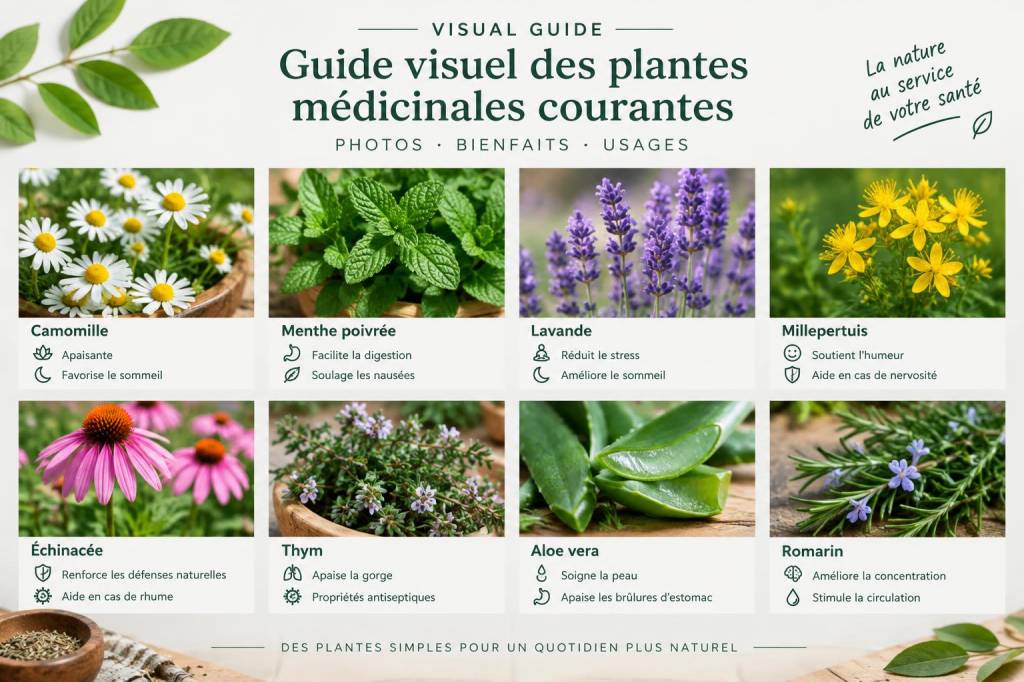
I often get asked for a practical, picture-led reference when readers want to start using herbs in everyday wellness routines. That's why I've created this guide visuel des plantes médicinales courantes — a visual, user-friendly tour of the most common medicinal plants you’re likely to encounter, how to recognise them, and simple, safe ways to use them at home.
Why a visual guide matters
Plants can be deceptively similar. Mistaking one leaf for another is a common cause of ineffective remedies—or worse, accidental poisoning. In my experience, pairing a short botanical description with a clear photo (or memory of a photo) reduces error and builds confidence. Visual cues—leaf shape, flower colour, growth habit—are often faster and more reliable than Latin names when you’re harvesting or buying herbs.
How I organised this guide
I focused on herbs that are widely available, evidence-backed to varying degrees, and safe for casual home use when used appropriately. For each species I provide:
Top 12 medicinal plants you should know (visual cues + uses)
Below are concise visual notes and practical uses. I recommend cross-checking photos from trusted botanical sources before harvesting in the wild.
| Plant | Visual ID | Common uses | Precautions |
|---|---|---|---|
| Chamomile (Matricaria chamomilla) | Small daisy-like flowers, white petals, yellow centre; feathery leaves | Calming tea, sleep aid, digestive soothe, topical for irritation | Allergy if sensitive to Asteraceae family |
| Peppermint (Mentha × piperita) | Bright green serrated leaves, strong menthol smell, square stems | Digestive tea, headache relief (topical dilute), aroma | Avoid in GERD; dilute for topical use |
| Lavender (Lavandula angustifolia) | Spikes of purple flowers, grey-green narrow leaves, aromatic | Relaxation, sleep, minor burns (diluted oil), anxiety support | Can cause skin irritation if undiluted |
| Calendula (Calendula officinalis) | Bright orange/yellow daisy-like flowers, glossy petals | Topical for cuts, skin soothing balms, anti-inflammatory creams | Possible allergy to Asteraceae |
| Ginger (Zingiber officinale) | Knobbly brown rhizome, fibrous inside, green lanceolate leaves | Nausea relief, anti-inflammatory, tea for digestion | May interact with blood thinners in high doses |
| Echinacea (Echinacea purpurea) | Pinkish coneflowers, prominent central cone, rough stems | Immune support (short-term), cold symptom reduction | Not for long-term immune modulation; allergy possible |
| Lemon balm (Melissa officinalis) | Heart-shaped serrated leaves, lemon scent when crushed | Calming tea, antiviral topical use for cold sores, digestive aid | Generally safe; may cause drowsiness |
| St. John’s Wort (Hypericum perforatum) | Yellow star-shaped flowers, perforated leaves translucent when held to light | Mood support (mild-moderate depression), topical wound healing | Strong drug interactions (SSRIs, birth control, anticoagulants) |
| Aloe vera (Aloe barbadensis) | Thick, fleshy succulent leaves with gel interior | Topical burns, skin hydration, minor wound care | Ingested latex can be a strong laxative; use topical gel only |
| Rosemary (Rosmarinus officinalis) | Needle-like leaves, woody scent, small pale flowers | Cognitive support (aroma), culinary, topical massage oil | High-dose extracts can be problematic in pregnancy |
| Thyme (Thymus vulgaris) | Tiny oval leaves, woody stems, small clustered flowers | Antiseptic for cough syrups, culinary, topical antiseptic | Concentrated essential oils are potent—dilute well |
| Yarrow (Achillea millefolium) | Feathery leaves, flat clusters of small white flowers | Stops minor bleeding, anti-inflammatory, digestive bitter | Photosensitising in some people; avoid in pregnancy |
How to use photos effectively when identifying plants
When I take photos for my own reference, I capture multiple angles and details: full plant, leaf close-up, stem texture, flower close-up, and growth habit (clump, single stem, groundcover). If you’re comparing with online images, make sure the source uses high-resolution images and includes seasonal variations.
Safety basics and stats
Herbal safety is often underestimated. Consider these figures:
Always check for interactions with prescription medications and consult a healthcare professional if you’re pregnant, breastfeeding, immunocompromised, or on regular medication.
Practical preparation tips (what I do at home)
Simple preparations I use and teach:
Where to learn more (trusted sources)
When I research, I rely on peer-reviewed and institutional sources to verify safety and efficacy. Recommended reading:
Common questions I hear
Below I address frequent reader concerns in plain language.
Quick checklist before using any medicinal plant
Sources cited and recommended for further reading: World Health Organization (WHO), PubMed/NCBI, Royal Botanic Gardens Kew. For a visual catalogue and species-by-species photos, refer to the linked guide visuel des plantes médicinales courantes in this article’s opening paragraph — it’s a great companion to the notes here.