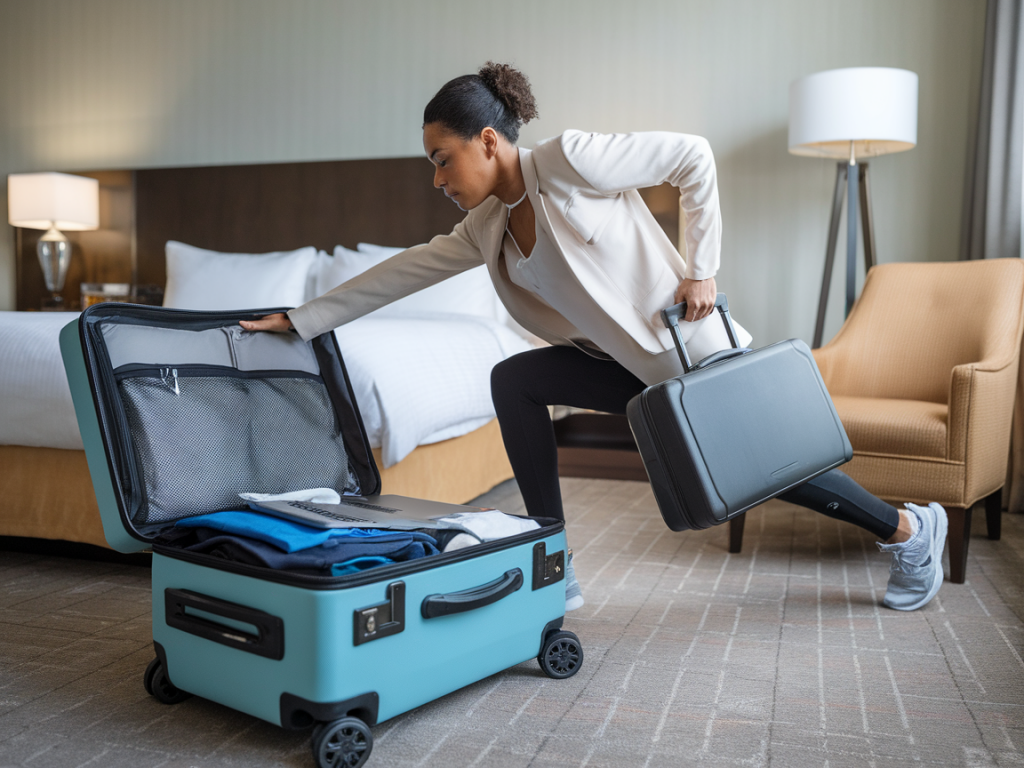
Business trips can feel like the enemy of energy: long meetings, strange beds, limited time, and a hotel room that feels more like a waiting room than a space to move. Over the years I learned how to protect my vitality on the road with a simple, suitcase-friendly strength routine that fits in 20 minutes and needs almost nothing. I keep it practical, effective, and kind to tired bodies — exactly the approach I share at Phnxfitness Co.
Why a 20-minute hotel-room strength routine works
People often ask me, "Is 20 minutes enough?" My answer: absolutely — when you focus on compound movements, use time efficiently, and prioritize consistency. This short routine boosts circulation, preserves muscle, improves posture after long flights, and gives you that mental reset to face a busy day. You don’t need a gym to maintain strength or feel more energized.
What I pack (suitcase-friendly essentials)
- Light resistance band (loop band or flat band): weighs almost nothing and allows for rows, presses, and glute work.
- Mini door anchor or lightweight suspension trainer (optional): fits in a small pouch and opens more movement options.
- Collapsible water bottle or full bottle for added weight.
- Comfortable shoes — I always pack trainers even if I plan to do bodyweight moves.
- Clothes you can move in — I keep a set ready on top of my suitcase for travel days.
Quick warm-up (3–4 minutes)
I start each session with a brief warm-up to wake up my nervous system and joints. It’s simple, portable, and keeps injuries away.
- 30 seconds marching or jogging on the spot
- 30 seconds arm circles + shoulder rolls
- 30 seconds hip hinges (reach forward, feel hamstrings) or standing toe touches
- 1 minute dynamic lunges or alternating knee drives
20-minute strength routine — structure and variations
I design this block around four circuits, each targeting a different movement pattern: push, pull, hinge, and squat + core. You’ll do two rounds of each circuit with minimal rest so you stay in the 20-minute window.
| Time allocation | What to do |
| Minutes 0–3 | Warm-up (see above) |
| Minutes 3–11 | Circuits 1 & 2 (2 rounds each, ~4 minutes per circuit) |
| Minutes 11–19 | Circuits 3 & 4 (2 rounds each) |
| Minutes 19–20 | Short cool-down stretch or breathing |
Full routine — exercises and cues
I list the exercises with simple cues and progressions. If you only have a band and a chair, you’re covered.
- Circuit 1 — Push (2 rounds)
- 10–12 incline push-ups (hands on desk or bed): keep body straight, lower with control.
- 10 band overhead presses (or water-bottle presses): anchor band under foot or stand on it.
- 30 seconds plank or plank on knees.
- Circuit 2 — Pull (2 rounds)
- 10–12 band rows (loop band around door handle or under foot): squeeze shoulder blades.
- 8–10 single-arm band pull-aparts or face pulls (more posture focus).
- 30 seconds dead-hang or active shoulder mobility (if using suspension trainer).
- Circuit 3 — Hinge + Posterior Chain (2 rounds)
- 12 banded Romanian deadlifts (stand on band, hinge from hips, slight knee bend).
- 10 hip thrusts on bed or glute bridges (single-leg option to progress).
- 30 seconds Superman holds (low back and glutes) or reverse plank.
- Circuit 4 — Squat + Core (2 rounds)
- 12 chair-supported squats or split squats (use bed edge for Bulgarian split squat).
- 12–15 walking lunges in the room or static lunges (each leg).
- 30 seconds bicycle crunches or dead bugs for core stability.
How to adjust intensity and time
People ask, "What if I'm very tired after travel?" or "What if I only have 10 minutes?" Here’s my quick guide:
- Low energy: Reduce rounds to one per circuit, focus on form and breathing.
- Short on time (10 minutes): Pick two circuits (push + pull or hinge + squat) and do one round each with slightly higher tempo.
- Want more intensity: Add a third round, slow the eccentric (lowering) phase, or add pulses at the end of each set.
Modifications for common constraints
Hotel rooms and business schedules create unique constraints. Here’s what readers often ask and how I respond:
- Small or cluttered room: Do movements facing the bed to use it for support. Use the back of a sturdy chair for balance.
- Thin mattress/soft bed: Avoid heavy hip thrusts—do bridges on the floor or use the chair.
- No band: Replace band rows with towel rows (wrap towel around door handle) or do single-leg deadlifts using bodyweight and balance.
- Jet lag or soreness: Prioritize movement that feels restorative — longer warm-up, mobility-focused sets, and short holds instead of high reps.
Short cool-down and sleep-friendly tips
I always finish with a calming 60–90 seconds: deep belly breaths, shoulder releases, and a single forward fold to lower heart rate. If I’m heading into an evening meeting or plan to nap, I add a 5-minute progressive relaxation: tense each muscle group for 5 seconds then release, from feet to head. This routine helps my body switch from travel stress to grounded calm — and usually improves sleep quality.
Real-world example — my last business trip
Last month I had back-to-back meetings and a tiny hotel room. I unrolled my resistance band, set a timer on my phone for 20 minutes, and followed the circuits. I felt more alert for my afternoon calls and less hunched over by dinner. A small habit like this became my anchor between hectic schedules — and it only takes a suitcase-sized effort.
Quick FAQ people ask me
- How often should I do this on a trip? Aim for 3–4 times per week if you can. Even twice will preserve strength and energy.
- Will this build muscle? It helps maintain muscle and strength. To build significant muscle you need progressive load over time, but for travel maintenance this routine is excellent.
- Is it safe if I have chronic back pain? Usually yes with careful progressions, but check with your healthcare provider. Focus on hinge mechanics, glute activation, and avoid painful movements.
- Any recommended brands? I like lightweight bands from TheraBand or Fit Simplify for travel. For suspension trainers, the TRX or more budget-friendly trainers both pack well.
If you're ready to try this, pack one band, set 20 minutes aside, and prioritize consistency over perfection. Start small, be kind to your body, and remember: movement on the road is a smart, simple act of self-care that keeps you rising stronger.